
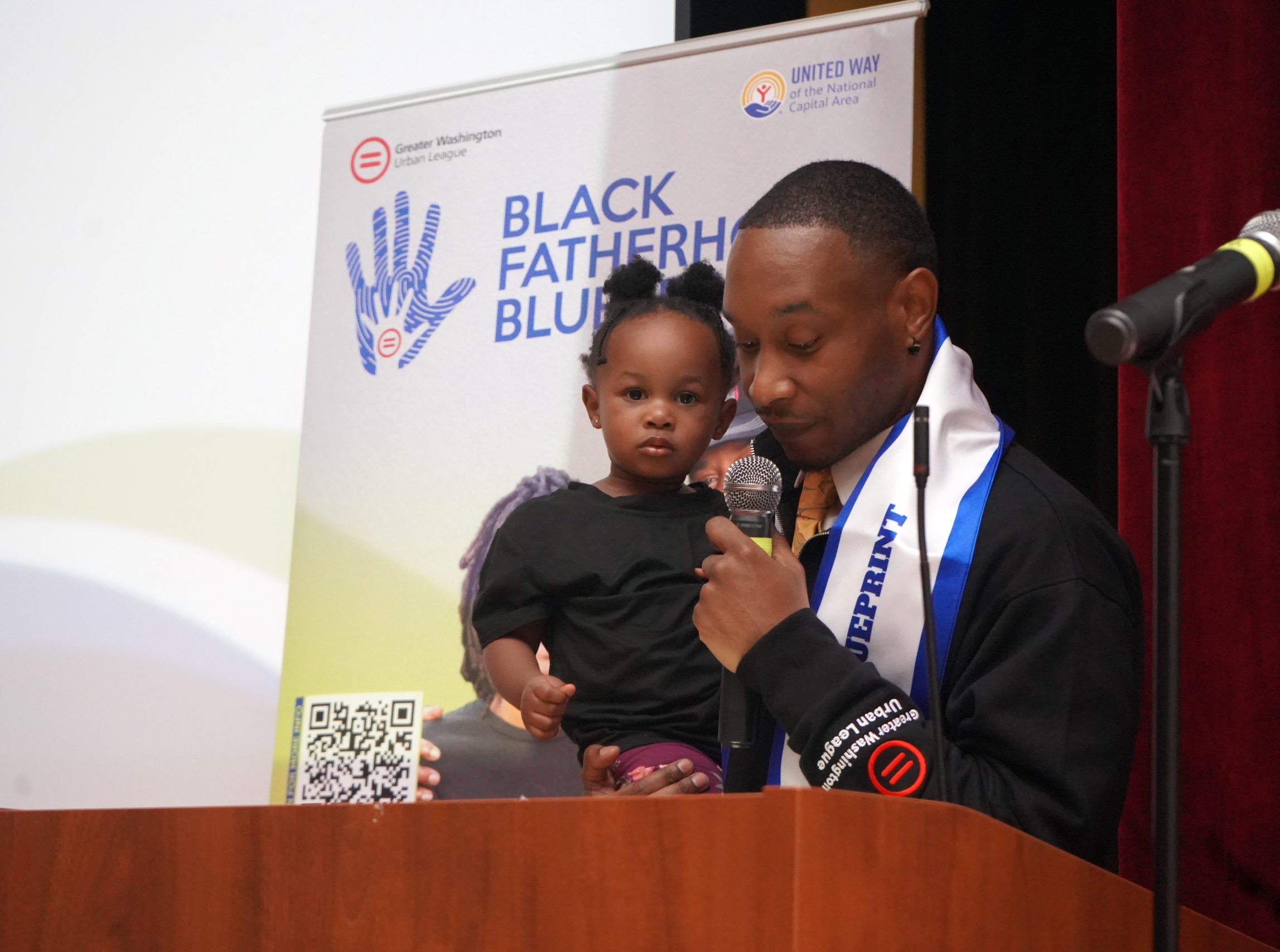
The Greater Washington Urban League (GWUL) and United Way of the National Capital Area (United Way NCA) honored dozens of men and their families during April 25’s Black Fatherhood Blueprint (BFB) graduation.
The class was BFB’s second cohort after a successful inaugural class in 2025.
“We need to make sure our families are strong—families make up our community—and making sure our communities are stable. That can’t happen without fathers,” GWUL Chief Administrative & Financial Officer Kimberly Corbin said. “When fathers are absent, families are weakened and generational wealth does not happen, which means communities become subject to decades of poverty and disinvestment.”
The 35 men honored at the graduation ceremony completed the initial 10-week coursework of the yearlong program. It includes healing circles and peer mentorship, legal aid, financial assistance, career advancement, and family reconnection.
“My family is getting the best part of me. This helps our mental health. That’s what this course helps us with mental health, breathing,” program graduate Darius Hancock said. “What brought me here (to graduation day) was forming a community with my fellow brothers who shared the same struggles, who share the same ups and downs with each other. I feel like this is a ‘forever’ type of bond I’ve build with these men. This program is helping me prepare for the best part of me.”
United Way NCA partners with GWUL on the program, providing guidance and data management. It also leverages existing support provided through our Washington, D.C. Financial Empowerment Center. The men have eight more months of additional financial coaching and therapy.
“There’s this narrative about Black fathers not being around, not being present, not being fathers to their children and being part of their families. We know that’s not true from the data,” GWUL Director of Health & Wellness Dr. Hanna Tessema said. “A sense of belonging is one of those outcomes we didn’t necessarily set out and say, ‘This is what we want to achieve,’ but it’s one of the biggest outcomes so far.”
Graduate Wendell Whren was honored with perfect attendance in the program.
“I never graduated from anything, so this is like my high school graduation,” Whren said. “I did 10 years in prison and one of the things that led me to prison was my dad’s inability to know how to be a dad. I didn’t want to be who my father was to me to my own children, and I know I couldn’t do that on my own knowledge and my own willpower.”
Whren’s mother Shannon cheered as her son crossed the stage.
“I’m so proud of my son. I’m trying not to cry, because he has overcome so much as a young father,” Shannon said.
Fathers participated in the Baobab Curriculum to learn about healthy relationships, manhood and father responsibilities, child development, career advancement, and financial empowerment. Participants also engaged in Sawubona Healing Circles, designed to take fathers through a journey of community and personal healing. Sawubona Healing Circles are led by the Association of Black Psychologists, and Brotherhood of Black Fathers Support Groups, led by Concerned Black Men.
“I’ve developed a network. I’ve developed a brotherhood. I’ve cried with these guys, yelled with these guys. We’ve played. Our kids have interacted,” Wendell Whren said. “I’ve gained some really amazing, supportive, loving, strong men in my corner.”
The program’s third cohort will celebrate its induction June 2026.
Explore how United Way of the National Capital Area is supporting ALICE families journey to stability through community partnerships. To learn more about the Black Fatherhood Blueprint, visit https://gwul.org/blackfatherhood/.